
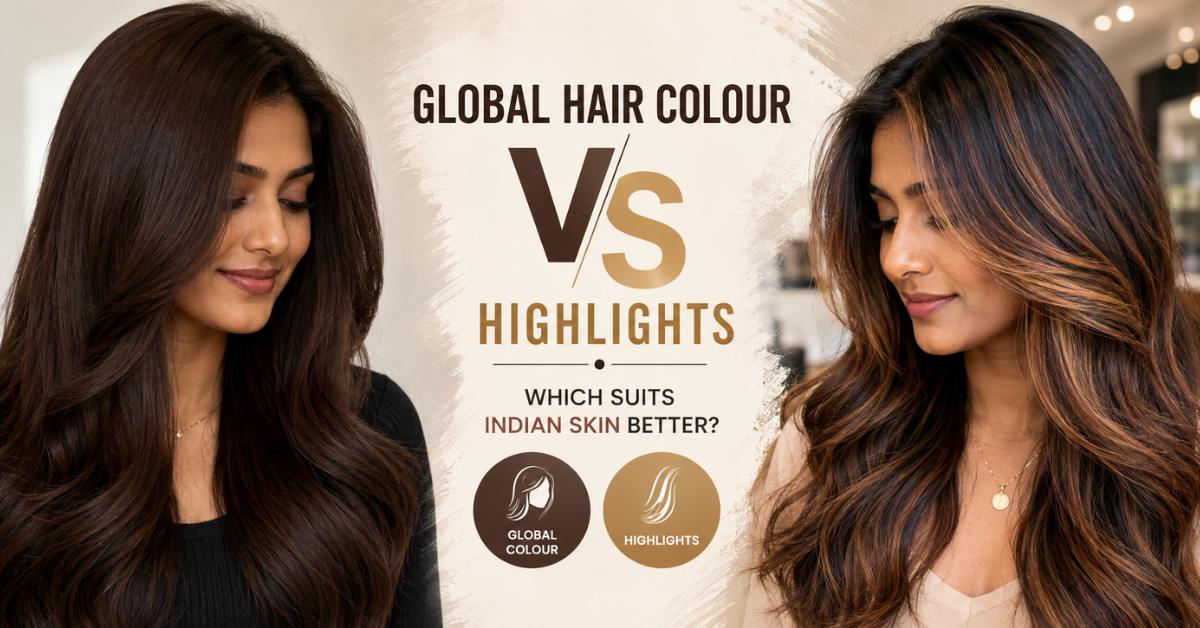
Thinking about colouring your hair but stuck choosing between global hair colour and highlights? You’re not alone. Both can transform your look, but they work in completely different ways. The right choice for global hair colour for Indian skin tone depends on your undertone, lifestyle, budget, and how much upkeep you’re ready for. This guide breaks everything down so you walk into your salon appointment already knowing what suits you.
|
Quick Answer: Which is Better for Indian Skin? For most Indian skin tones, highlights work better because they add natural dimension without overpowering warm undertones. Global hair colour suits those who want complete grey coverage or a bold, uniform transformation. Fair to medium wheatish tones look great with warm global shades, while dusky and deep skin tones shine with caramel or copper highlights. |
What is Global Hair Colour?
Global hair colour means applying one shade evenly across your entire head, from roots to tips, in a single salon sitting.
- How it works: Your colourist mixes the chosen shade and applies it strand by strand until full, even coverage is achieved. Processing takes roughly 45–90 minutes.
- Best candidates: First-time colour users, anyone with visible grey hair, and people wanting a dramatic, uniform change.
- Maintenance: Root touch-ups every 4–6 weeks as new growth appears.
- Cost in India: Around ₹1,500–₹6,000, depending on hair length, product quality, and salon tier.
- Pros: Even, opaque coverage; excellent for greys; consistent colour result.
- Cons: Root regrowth is noticeable within weeks; can look flat without added dimension.
What are Hair Highlights?
Highlights colour only select strands, leaving your natural base visible underneath. This creates depth and movement instead of colouring every strand.
- Foils: Traditional strand-by-strand lightening for precise, structured highlights.
- Balayage: Hand-painted, sun-kissed strokes with soft, natural transitions and no harsh lines.
- Babylights: Ultra-fine highlights that mimic natural childhood hair colour.
- Ombre: A gradual shift from a darker root to lighter ends.
- Face-framing highlights: Brightening strands placed only around the face for an instant glow.
Global Hair Colour vs Highlights: Comparison Table
| Factor | Global Hair Colour | Highlights |
| Coverage | Full head, root to tip | Partial, selected strands |
| Hair appearance | Uniform, flat single tone | Multi-tonal, dimensional |
| Natural look | Can look bold/dramatic | Blends naturally with base |
| Maintenance | Higher — visible regrowth | Lower — softer regrowth line |
| Salon time | 45–90 minutes | 90 minutes–3 hours |
| Hair damage | Moderate (single process) | Moderate to higher (lightening) |
| Colour longevity | 6–8 weeks before roots show | 3–6 months between refreshes |
| Touch-up frequency | Every 4–6 weeks | Every 3–6 months |
| Cost | ₹1,500–₹6,000 | ₹3,000–₹12,000+ |
| Suitable skin tones | All, shade-dependent | All, placement-dependent |
| Best for beginners | Yes | Yes, lower commitment |
| Fashion factor | Classic, elegant | Trendy, Instagram-friendly |
| Professional appearance | Polished, uniform | Natural, subtle |
Which Looks Better on Different Indian Skin Tones?
Shade selection matters more than the technique itself. Here’s what tends to work best across common Indian undertones.
Fair Skin
Global shades: Ash Brown, Mahogany. Highlight shades: Honey Brown, Soft Beige.
Light Wheatish Skin
Global shades: Chocolate Brown, Golden Brown. Highlight shades: Caramel, Honey Brown.
Medium Wheatish Skin
Global shades: Mocha Brown, Espresso. Highlight shades: Copper, Caramel.
Dusky Skin
Global shades: Burgundy, Mahogany. Highlight shades: Copper, Golden Brown.
Deep Indian Skin
Global shades: Espresso, Chocolate Brown. Highlight shades: Caramel, Copper.
A quick word of caution: very cool or overly platinum blonde shades tend to wash out warm Indian complexions and clash with the undertone. Warm browns, coppers, and caramels almost always look richer and healthier — but your colourist should confirm the exact shade during a consultation, based on your natural hair colour and hair health.
Who Should Choose Global Hair Colour?
- First-time hair colour users who want a simple, one-step change
- Anyone looking for full grey coverage
- Those who want a complete makeover, not a subtle shift
- People who prefer a polished, professional, uniform look
- Anyone who loves a consistent, single-tone colour
Who Should Choose Highlights?
- Anyone wanting a subtle transformation, not a total colour change
- Those looking for lower long-term commitment
- People who want face-framing brightness without full colour
- Anyone chasing dimension and movement in their hair
- Fans of modern, trend-forward looks
- Those wanting comparatively less overall chemical exposure to the scalp
Expert Recommendation
As a rule of thumb: choose global hair colour when your main goal is grey coverage or a bold, complete change — it gives the most uniform, predictable result. Choose highlights when you want dimension, a face-brightening effect, or a lower-maintenance routine that grows out gracefully. Many of our clients at the salon actually get the best of both worlds by starting with a global base colour and adding face-framing highlights on top — this covers greys while still giving natural depth. Your stylist will confirm what works after examining your natural hair colour, any previous chemical treatments, and overall hair health.
Quick Decision Guide
| If You Want | Choose |
| Grey coverage | Global Hair Colour |
| Natural dimension | Highlights |
| Low maintenance | Highlights |
| Bold makeover | Global Hair Colour |
| Budget-friendly option | Global Hair Colour |
| Luxury salon look | Balayage Highlights |
| Professional office appearance | Global Hair Colour |
| Instagram-worthy hair | Highlights |
Hair Colour Maintenance Tips
- Use a sulfate-free shampoo to prevent premature colour fading
- Follow up with a colour-safe conditioner for shine and softness
- Apply heat protection spray before styling with hot tools
- Use leave-in products with UV protection to prevent sun-fading
- Deep-condition with a hair mask once a week
- Book root touch-ups every 4–6 weeks (global) or refresh highlights every 3–6 months
Frequently Asked Questions
What is the difference between global colour and highlights?
Global colour covers your entire head in one uniform shade, while highlights colour only selected strands to add dimension. Global colour changes your overall base tone; highlights enhance and brighten specific sections without altering the rest of your natural hair colour.
Which lasts longer, global colour or highlights?
Highlights generally last longer between touch-ups — around 3 to 6 months — because regrowth blends more naturally. Global colour needs root touch-ups every 4 to 6 weeks since new growth creates a visible line against the coloured hair.
Which is better for Indian skin — global colour or highlights?
Both work well, but highlights suit most Indian skin tones best because they add warmth and dimension without overwhelming the complexion. Global colour is the better pick specifically for full grey coverage or when you want one dramatic, uniform shade change.
Can I get highlights after global hair colour?
Yes. Many clients add face-framing or balayage highlights on top of an existing global colour for extra dimension. Your stylist should assess your hair’s current condition first, since layering chemical processes can increase dryness if not spaced out properly.
Do highlights damage hair more than global colouring?
Highlights typically involve a lightening process, which can be slightly more damaging to the lightened sections than a single-process global colour. However, since only part of the hair is treated, overall stress on the scalp and hair is often comparable or lower.
Which option requires less maintenance?
Highlights require less frequent salon visits since regrowth is softer and less noticeable. Global colour needs more regular root touch-ups to maintain an even, fresh look, especially if you have visible greys.
Which hair colouring method looks more natural?
Highlights generally look more natural because they mimic the way hair lightens with sun exposure, creating realistic tonal variation. Global colour looks more uniform and polished, which some people prefer for a formal, professional appearance.
Are highlights suitable for dark Indian hair?
Yes, highlights work beautifully on dark Indian hair, though the natural darkness means strands need proper lightening to show warm tones like caramel or copper clearly. A professional consultation helps decide the right technique and processing time for dark hair.
Conclusion
Global hair colour and highlights both have a place in Indian hair colouring — the right pick simply depends on your goals. If you want full grey coverage or a bold, uniform transformation, global colour is your best bet. If you want natural dimension, a face-brightening effect, and lower long-term maintenance, highlights are the smarter choice. Fair and light wheatish tones tend to glow with warm browns and honey highlights, while dusky and deep skin tones look richest with caramel and copper. Whichever you lean towards, book a professional consultation before your appointment — your stylist can confirm the ideal shade based on your natural hair colour, hair health, and any previous chemical treatments.



1 Comment
Eikon9
September 5, 2026[…] For a full side-by-side breakdown, read our guide: Global Hair Colour vs Highlights: Which Suits Indian Skin Better? […]