Choosing the right hair colour for Indian skin tone is a lot harder than scrolling Pinterest and copying whatever a celebrity is wearing that week. Indian skin isn’t one shade — it spans fair to deep, and within every one of those categories, undertone matters far more than how “fair” or “dusky” someone considers themselves. A caramel balayage that looks radiant on a friend with warm, golden undertones can look flat and slightly yellow on someone with cool, pink-based skin, even if both are described as wheatish.
This guide breaks down hair colour for Indian skin tone by undertone rather than fairness alone, covers the shades trending in Indian salons through 2026, flags the mistakes that lead to regret-colouring, and explains how to actually maintain colour-treated hair in Indian heat, humidity, and hard water.
Quick answer: The hair colour that best suits most Indian skin tones is a warm-toned brown — chocolate, chestnut, or caramel — since the majority of Indian complexions carry golden or olive undertones. Cooler undertones do better in ash brown, mocha, or soft black, while dusky skin looks richest in espresso, mahogany, or auburn.
Understanding Indian Skin Tones
Indian skin tones are usually grouped into six broad categories — fair, light-medium, wheatish, olive, dusky, and deep. These are useful starting points, but they only tell half the story.
- Fair: Pale skin with minimal melanin, can carry either warm or cool undertones.
- Light-Medium: Slightly deeper than fair, often neutral-to-warm.
- Wheatish: The most common Indian skin tone — a warm beige-brown, usually golden or olive undertoned.
- Olive: Greenish-warm undertone with a muted, earthy quality.
- Dusky: Deep warm-brown skin, often with rich golden or red undertones.
- Deep: The richest end of the spectrum, typically warm or neutral undertoned.
The undertone underneath each of these — warm, cool, or neutral — is what actually decides which hair colour will flatter you:
- Warm undertone: Skin has golden, yellow, or peachy hints. Gold jewellery flatters more than silver.
- Cool undertone: Skin has pink, red, or bluish hints. Silver jewellery flatters more than gold.
- Neutral undertone: A balanced mix of both — most colours in the mid-range work well.
| Skin Tone | Common Undertone | Recommended Hair Colours |
| Fair | Warm or Cool | Ash brown, honey blonde, copper, auburn |
| Light-Medium | Neutral to Warm | Chestnut, caramel, soft brown |
| Wheatish | Warm / Olive | Chocolate brown, caramel, burgundy, chestnut |
| Olive | Warm / Neutral | Mocha, cinnamon brown, honey brown |
| Dusky | Warm / Deep | Espresso, mahogany, auburn, deep burgundy |
| Deep | Warm / Neutral | Dark cherry, soft black, deep mahogany |
Best Hair Colour for Indian Skin Tone
Here’s how the most popular shades perform across Indian skin tones — who each one suits, the benefit it delivers, and roughly how much upkeep to expect.
| Shade | Who It Suits | Key Benefit | Maintenance |
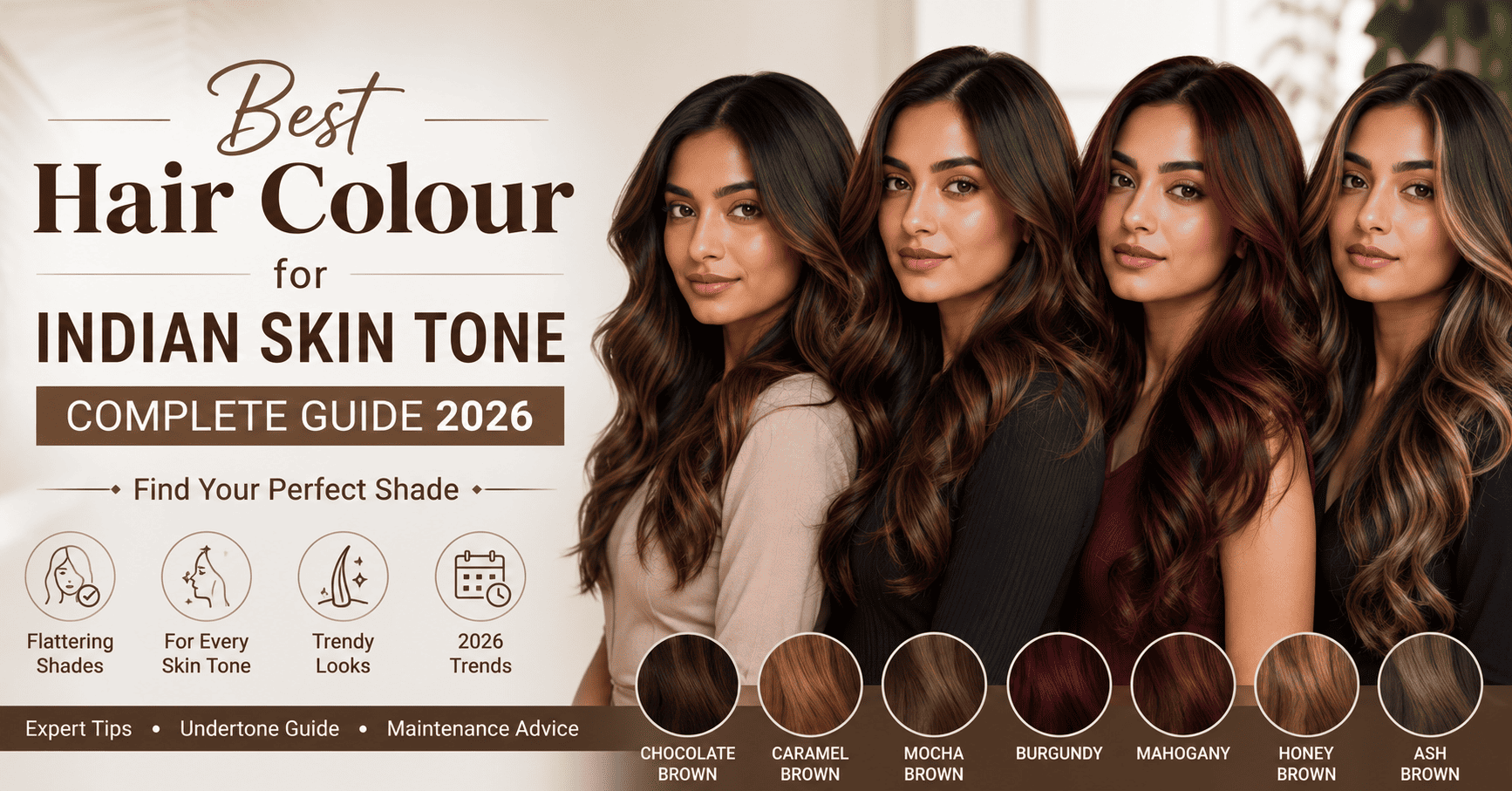
| Chocolate Brown | Wheatish, light-medium, warm undertones | Natural depth, blends with dark Indian base hair | Low — gloss every 8–10 weeks |
| Dark Brown | Almost all Indian skin tones | Safe, universally flattering, subtle change | Very low — soft regrowth line |
| Mocha Brown | Olive, neutral undertones | Balanced grey-brown, neither too warm nor cool | Moderate — toner refresh every 6 weeks |
| Espresso Brown | Dusky, deep skin | Rich near-black depth with warmth | Low |
| Caramel Brown | Wheatish, fair, warm undertones | Brightens the face, ideal for highlights | Moderate — touch-up every 6–8 weeks |
| Honey Brown | Fair to wheatish, warm undertones | Sun-kissed glow, flattering in daylight | Moderate |
| Chestnut Brown | Wheatish, olive undertones | Warm reddish-brown, festive-ready | Low to moderate |
| Burgundy | Wheatish, dusky, deep skin | Vibrant without looking unnatural | Moderate — fades faster, monthly gloss |
| Mahogany | Dusky, deep, olive skin | Deep red-brown, dramatic yet wearable | Moderate |
| Auburn | Dusky, warm/olive undertones | Radiant copper-red warmth | Moderate to high — fades fastest |
| Copper Brown | Fair, wheatish warm undertones | Bold, statement colour | High — needs frequent gloss |
| Cinnamon Brown | Wheatish, olive undertones | Trending warm, spiced tone | Moderate |
| Soft Black | Cool undertones, any depth | Clean, classic, editorial finish | Low |
| Dark Cherry | Dusky, deep skin | Rich red-black, bridal favourite | Moderate |
| Ash Brown | Cool undertone, fair/light skin ONLY | Smoky, cool-toned finish | High — needs purple shampoo |
A word of caution on ash brown: it’s genuinely lovely on cool-undertoned fair or light-medium skin, but on warm or olive undertones it tends to look greyish and can dull the complexion rather than flatter it — one of the most common colour regrets we see at Eikon.
Blonde Highlights: When They Work (and When They Don’t)
Partial blonde — think caramel-blonde balayage or money-piece highlights around the face — works well on warm and wheatish Indian skin because it’s layered over a dark base and reads as sun-kissed rather than artificial. Full platinum blonde, on the other hand, is rarely a good idea for most Indian skin tones. It requires aggressive bleaching that damages the hair’s structure, tends to turn brassy within weeks against Indian water and pollution, and often clashes with warm or olive undertones instead of complementing them. If you love the blonde look, face-framing highlights or a caramel balayage will get you 80% of the effect with a fraction of the damage and upkeep.
Best Hair Colour for Wheatish Indian Skin
Wheatish is the single most common Indian skin tone, and thankfully one of the easiest to colour for. Because wheatish skin already carries warmth, colours that match or gently amplify that warmth — chocolate brown, caramel, honey brown, burgundy, and chestnut — tend to look the most natural. For a deeper dive into shade-by-shade recommendations, highlight placement, and balayage tips specifically for this skin tone, see our dedicated guide on Best Hair Colour for Wheatish Skin.
Chocolate brown and chestnut give a low-maintenance, natural-looking base. Caramel and honey brown highlights brighten the face without overwhelming it. Burgundy adds festive richness for weddings and celebrations. All of these work because they lean warm, just like the skin underneath them.
Best Hair Colour for Dusky Indian Skin
Dusky skin has enough natural depth to carry rich, dramatic colours that would look harsh on lighter skin. Espresso and mocha brown add dimension without straying too far from the natural base, while mahogany and auburn create warm contrast that makes the complexion look luminous rather than muted. Deep burgundy is a favourite for dusky skin during festive season because the red-brown base intensifies rather than fights the skin’s natural richness. For a complete breakdown of technique and placement, see our guide on Best Hair Colour for Dusky Skin.
The contrast principle is key here: dusky skin looks best when hair colour is either close to the natural base (for a polished, cohesive look) or deliberately warm and rich (for statement contrast) — cool or muted tones tend to flatten the complexion instead of enhancing it.
Best Hair Colour for Fair Indian Skin
Fair skin has more flexibility than any other tone because it can carry both warm and cool colours convincingly. Ash brown and honey blonde suit fair skin with cool or neutral undertones, while copper, auburn, and soft brown suit fair skin with warm undertones. The main risk for fair skin isn’t picking the wrong family of colour — it’s going too light or too cool without checking undertone first, which can wash out the complexion. Our detailed guide on Best Hair Colour for Fair Skin covers undertone-matching in more depth.
How to Choose Hair Colour Based on Undertone
If you only remember one rule from this guide, make it this: match your hair colour family to your undertone before worrying about the specific shade name. Two quick self-tests help confirm your undertone:
- Vein test: Green-toned veins on your wrist usually indicate a warm undertone; blue or purple veins indicate a cool undertone.
- Jewellery test: If gold jewellery flatters you more, you likely lean warm. If silver flatters you more, you likely lean cool.
| Undertone | Best Hair Colours | Avoid |
| Warm | Chocolate, caramel, honey, copper, chestnut, cinnamon | Ash brown, platinum blonde, cool lavender |
| Cool | Ash brown, mocha, soft black, cool-toned burgundy | Copper, honey, golden blonde |
| Neutral | Chestnut, mahogany, dark cherry, most mid-tone browns | Extremely warm or extremely cool tones |
Step-by-Step: Picking Your Hair Colour
- Identify your undertone using the vein test and jewellery test above.
- Match your undertone to a colour family using the table (warm, cool, or neutral).
- Decide on technique — full colour, highlights, or balayage — based on how much maintenance you’re willing to do.
- Do a strand test 24–48 hours before full application, especially if you have previously chemically treated hair.
- Consult your colourist about hair health, previous treatments (keratin, smoothening, henna), and realistic outcomes.
- Book your touch-up schedule in advance so upkeep doesn’t become an afterthought.
Trending Hair Colour Ideas in India (2026)
Indian hair colour trends in 2026 lean toward low-maintenance, natural-looking colour rather than dramatic all-over change — a shift driven largely by better colour technology and clients wanting fewer salon visits.
- Face-framing highlights: Money-piece highlights around the front sections brighten the face without a full-head commitment.
- Balayage: Hand-painted, graduated colour that grows out naturally. See our full Balayage Hair Colour Guide for technique and shade pairing.
- Chocolate balayage: A soft, low-contrast balayage in chocolate and caramel tones — the most requested balayage combination for Indian hair.
- Caramel highlights: Warm, golden-toned highlights that photograph beautifully and suit most warm Indian undertones.
- Mushroom brown: A cool-toned, ashy taupe-brown gaining popularity with neutral to cool undertones.
- Cherry cola hair: A glossy blend of deep burgundy and brown, popular for festive and bridal looks.
- Mocha mousse: A soft, muted brown with a slight grey cast — this year’s answer to “your hair but better.”
- Cinnamon brown: A warm, spiced reddish-brown that’s trending as an alternative to classic chestnut.
- Money-piece highlights: Two bold face-framing streaks, lower maintenance than full highlights.
- Glossy brunette shades: Semi-permanent glosses that add shine and warmth to natural brown hair without commitment to a full colour change.
Hair Colour Mistakes to Avoid
- Choosing a shade purely from a celebrity photo without checking if it matches your undertone.
- Ignoring undertone entirely and picking colour based on skin fairness alone.
- Going too light in a single sitting — this over-processes hair and often requires corrective colour later.
- Skipping the strand test, especially on previously coloured, keratin-treated, or henna-treated hair.
- Not switching to a sulphate-free, colour-safe shampoo immediately after colouring.
- Over-processing hair by combining bleaching, straightening, and colouring too close together.
- Underestimating the maintenance cost and time commitment of high-upkeep shades like copper or ash brown.
Hair Colour Maintenance Tips
- Use a sulphate-free shampoo formulated for colour-treated hair to slow fading.
- Follow with a moisture-rich conditioner to offset the dryness colour and bleach can cause.
- Deep-condition with a hair mask once a week, especially after bleaching or highlights.
- Apply a UV-protectant serum or spray — Indian sun fades warm tones faster than most people expect.
- Use a heat protectant before any blow-drying or styling on coloured hair.
- Stick to a touch-up schedule: roots every 4–6 weeks, gloss refresh every 6–8 weeks.
- Book a gloss or toner treatment between full colour sessions to keep vibrancy without added damage.
- Get regular trims every 8–10 weeks to prevent colour-treated ends from looking dry or brittle.
Frequently Asked Questions
Which hair colour suits Indian skin tone the most?
For most Indian skin tones, warm-toned browns — chocolate, chestnut, and caramel — are the most universally flattering, since the majority of Indian complexions carry warm or olive undertones. Cooler undertones look better in ash brown, mocha, or soft black instead.
What hair colour is best for wheatish Indian skin?
Wheatish skin pairs best with chocolate brown, caramel, honey brown, chestnut, and burgundy, since these shades complement the warm or olive undertones common in wheatish complexions without looking artificial.
Does blonde hair colour suit Indian skin tone?
Partial blonde — such as face-framing highlights or a caramel balayage — can suit warm and wheatish Indian skin tones well. Full platinum blonde is generally not recommended, as it requires heavy bleaching, tends to turn brassy quickly, and often clashes with warm or olive undertones.
How do I choose a hair colour based on my undertone?
Start with the vein test (green veins suggest warm undertone, blue or purple suggest cool) or the jewellery test (gold flatters warm undertones, silver flatters cool undertones). Then match your undertone to a colour family — warm undertones suit chocolate, caramel, and copper; cool undertones suit ash brown, mocha, and soft black; neutral undertones can wear most mid-tone browns.
Is balayage better than full hair colour for Indian hair?
Balayage generally requires less frequent touch-ups than full-head colour because it’s hand-painted to grow out naturally, making it a lower-maintenance option for Indian hair, though the right choice ultimately depends on how much overall change you want and your hair’s current health.
How often should I touch up my hair colour?
Most root touch-ups are needed every 4–6 weeks, while balayage and highlights can typically stretch to every 3–4 months. A gloss or toner refresh every 6–8 weeks helps maintain vibrancy in between.
Can I colour my hair after keratin or smoothening treatment?
Yes, but timing matters — most colourists recommend waiting at least two weeks after a keratin or smoothening treatment before colouring, and a strand test is essential since chemically treated hair can process colour differently.
Will hair colour damage my hair?
Any chemical colour process causes some degree of change to the hair’s structure, and results vary depending on your natural hair health, previous treatments, and how the colour is maintained afterward. Using sulphate-free products, deep conditioning regularly, and spacing out chemical services helps minimise damage.
Top Hair Colour Picks for Indian Skin Tone at a Glance
- Warm/wheatish undertones: Chocolate brown or caramel balayage
- Cool undertones: Ash brown or mocha brown
- Dusky skin: Espresso, mahogany, or deep burgundy
- Fair skin: Honey blonde, copper, or soft ash brown
- Festive/bridal: Dark cherry or burgundy
- Lowest maintenance overall: Dark brown or chocolate brown balayage